Philippine Internet : Slow & Expensive

Internet is increasingly becoming an important commodity in our daily life. Today, we can conduct our business online, do shopping, pay our bills, read the news, and transfer and deposit money to our bank account. But while the promise of Internet is sweet, we can only frown and scream at the unreliable infrastructure of Internet in the Philippines and how many of us remain unaware of the rights we have as consumers (if we ever have any) against services that don’t meet the expected acceptable level of customer satisfaction.

According to an index of internet speed, South Korea has the fastest internet in the world. The index also takes on quality, pricing, and consumer satisfaction. All these data are available over at netindex.com.

The Philippines comes in as 133rd in a list of 169 countries with a depressing average of 1.68 Mbps. And that's seemingly an overstatement as many users here are surfing at speeds way below that average while South Korea, our Asian neighbor, takes the top position with a whopping average of 32.03 Mbps.

What lies in front of the biggest telecommunications and internet service providers in the Philippines right now is a challenge as to how they will improve their services in providing a reliable and literally fast internet connection after the country has been listed 2nd in the world with slowest web page loading according to a study conducted by Google.

The government should really step up and ease the burdens we face when it comes to internet connectivity and speed, like last year when Senator Bam Aquino has begun proceedings to instigate an investigation aimed at getting to the root cause of the slow and expensive internet service in the country.

He was spurred on to take action after reports that internet speed in the Philippines is the slowest of all ASEAN countries, coming in below the ASEAN average 12.4 Mbps download speed. A recent study commissioned by the Internet Corporation for Assigned Names and Numbers (ICANN) revealed that the country’s internet infrastructure fares poorly in comparison to its ASEAN neighbors.

The senator filed a resolution with the Committee on Trade, Commerce and Entrepreneurship, which aims to address the issue. Aquino raised important points in his proposal, notably that poor internet connection can impede business operations, which in turn has an adverse effect on trade. Slow and costly internet can also have a negative impact on the country’s opportunities to advance their telecommunications services.
Aquino resolved that the way forward is to guarantee internet users a reliable, faster and cheaper service that is readily available and easier to access. He also raised the issue of the elevated expense of internet access in the Philippines, where it costs around 1,000 PHP (16 EUR) p/m for up to 2Mbps download speed and 2,000 PHP (32 EUR) p/m for up to 5 Mbps.

He explained, “Comparing the prices of internet services among Southeast Asian countries, the cost to Filipino consumers is way more expensive than the internet costs in Singapore and Thailand, which have the fastest connections globally.”

I hope one day Philippines would advance to having a faster internet speed, because faster internet will mean better education, more efficient businesses, more attractive markets to foreign investment, better economy, and of course more informative posts from my blog.
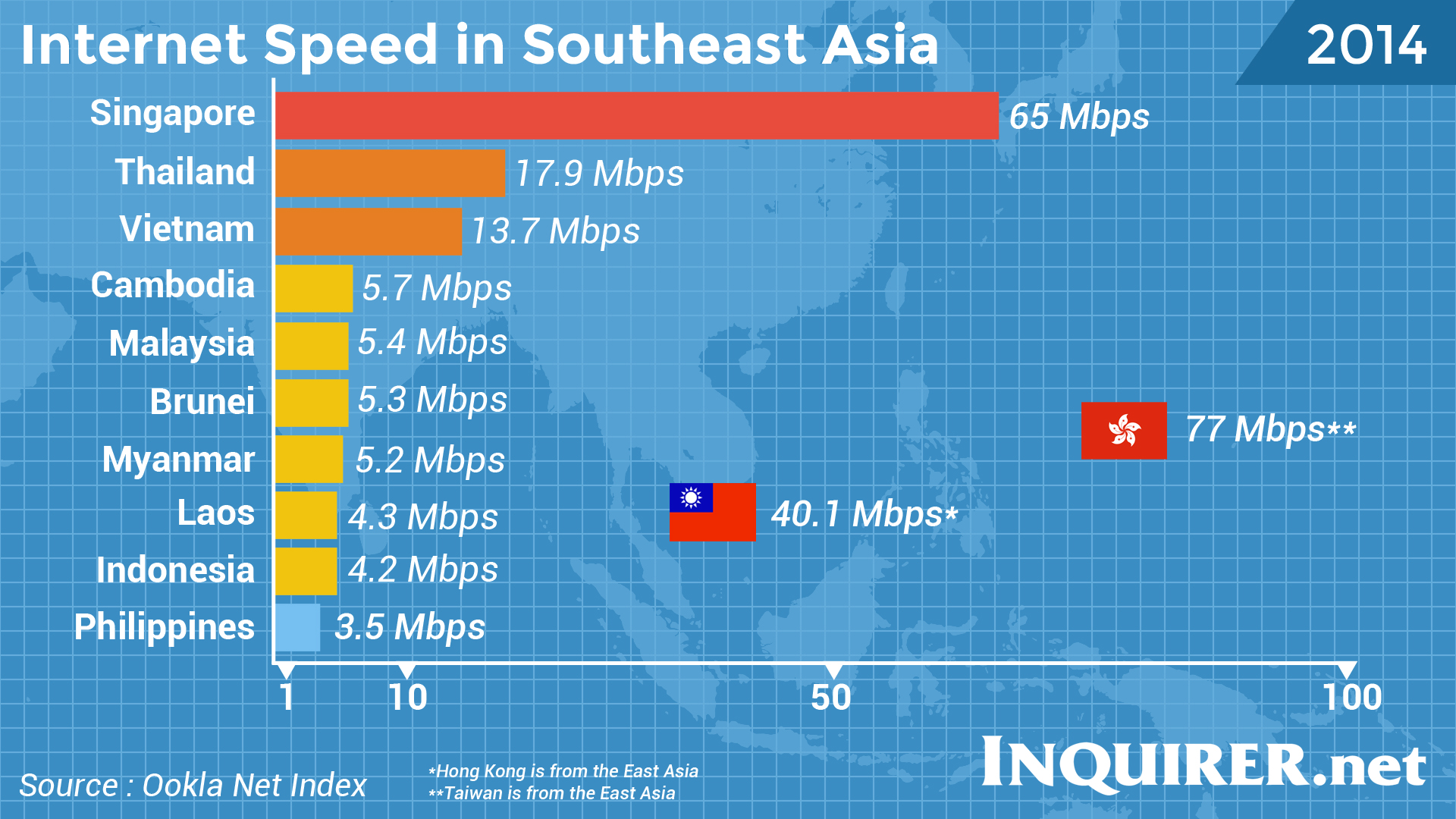

photo from: Inquirer.net

Internet Penetration in Asia

Asia is one of the most diverse and fast changing regions in the world. It’s home to over 4 billion people spread across 48 different countries.
I have done my research about the growth of internet population and penetration in Asia and I have discovered two important trends:

First, the rise of Asia as the main contributor to the world’s Internet population; 44.8% of the world’s Internet users live in Asia. China, India, and Japan alone host more Internet users than Europe and North America combined.

Second, few of the world’s largest Internet countries fall into the top category (>80%) of Internet penetration (and indeed India falls into the lowest category, at <20% penetration). In other words, in all of the world’s largest Internet nations, there is still substantial room for growth.

Singapore is the leader in internet penetration, but Indonesia is far and away the regional leader in number of internet users. The regional average internet penetration is 34.7 percent but the differences are so drastic that it’s not a particularly useful statistic. After all, East Timor and Myanmar’s internet penetration sit far below even the 10 percent that Laos enjoys and Singapore, Brunei, and Malaysia are above 50 percent. And according to my self-research, it’s pretty clear that Indonesia, Philippines, Vietnam, Malaysia, and Thailand are Southeast Asia’s most promising large internet countries.

I believe that Asians are very heavy and frequent Internet users. First world countries in Asia have it better since they have the capacity and the means to have high-speed connection. While on the other hand, third world countries may have slow and mediocre internet speed, but most of its citizens, us Filipinos--for example, are not hindered by it. In fact, we are one of the most frequent users around the globe.

#MayIlawNa

#MayIlawNa

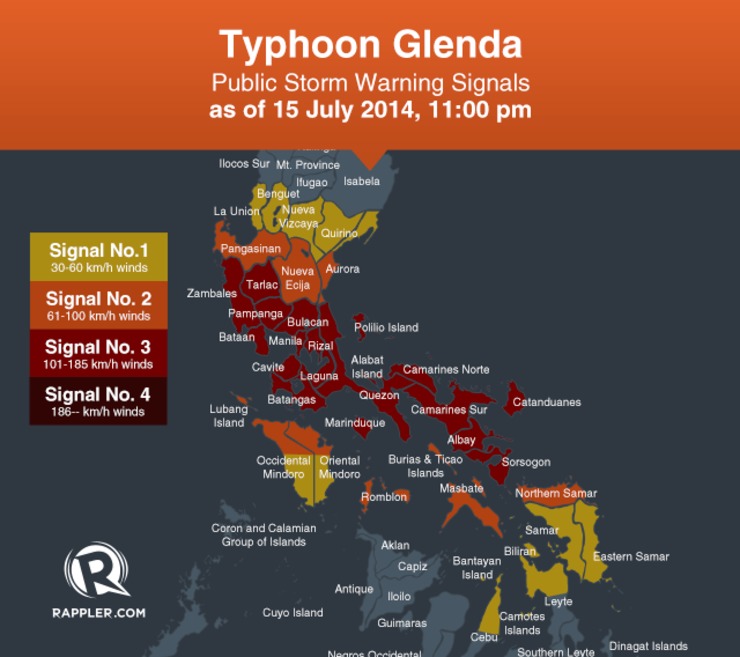
For people like me who just stayed home and slept through Typhoon Glenda and was only without power for only a couple of hours after the typhoon's devastation, it wasn't really difficult for me to cope up. But for many who lost their homes, their families and love ones, friends, I couldn't imagine how tough those times could be — the grief and despair.

For most modern Filipino's, loss of power means the complete loss of normalcy. Our lifestyle is so dependent upon the grids constancy that we don't know how to function without it. How do you cook a meal if your gas stove has an electric ignition? How do you find your way to the bathroom at night if the light switches don't work? What do you do with a freezer full of expensive meat? How do you find out what's happening in your area with the TV and radio silent? What will you drink if your water comes from a system dependent on electrical pumps?
After the devastation that Typhoon Glenda brought us, these are just a few questions that we should seriously start to consider.
Like, thousands of families in different regions in our country, most of our relatives and close friends was without power for a couple of days, even a week or more since last week.
We consider ourselves lucky our place was only out-of-power for a few hours.

As we are in the middle of 2014, much of our social communication is done via technology. We create distance and are dependent upon technology for entertainment, and in most cases, for a distraction from such intimate and consistent communication with those closest to us.
For me, it felt unnatural to be sitting around, talking, listening, and being with the same people hour after hour — with no breaks. That's tough enough, but when the lights are out and it's full of silence, I was really tested.

Much of surviving the aftermath of this recent typhoon had to do with finding real clean water and cleaning the mess out of our property, another critical component of surviving involved communicating in close quarters with loved ones.

In our case, we are talking about me and my partner. I sensed that my partner and I were on each other's nerves more than usual. It soon became clear that we weren't the only ones, my friend, Paris, said that his family and neighbors experience some of the same communication "issues".

Sure, it sounds great in theory that we are going to get to spend a lot of quality time as a couple or with other we care about, but the truth is, too much familiarity may not breed contempt, but it does produce pressure. And so, if we overreact to that initial tension, we can make a not so bad situation a lot worse.
Even if you have the best intensions, that doesn't mean that those who are stuck with you are going to understand or appreciate where you are coming from. Different people have different ways on how to handle an emergency. The key is to be flexible.

If we can better understand how difficult it is for everyone to cope with power outage and calamities, in this day and age, we could be more efficient in interacting and communicating, be more patient and cooperating.

xx
Photo from Rappler.com

How Communication Has Changed

Communication is the process of conveying information. Almost all species have some sort of communication system. However, successful communication is the trait that has made humans the most successful species.
My first blog entry shows a timescale of how communication has evolved over time. It’s hard to imagine communication long before the hustle and bustle of email and text messaging. Technological communication has grown exponentially, leaving snail mail to be a thing of the past.


Means of communication has changed drastically throughout the years from the Pony Express to video conferencing with people around the world. With the help of various types of technology, the world has become even more proficient in the ways the world can communicate.

● Between 1860 - 1861. According to sfmusuem.org journeys were done to deliver letters that were written on a tissue paper. The cost of delivering was approximately $5 for 1,800 Miles.
● Many believed that Alexander Graham Bell should be credited for the invention of the telephone. However, according to M. Bellis, Mr. Bell had some competition from Elisha Gray. The two men both tried to get the patent for the telephone. According to this source, Bell won in 1870.
● According to About.com in 1902 Guglielmo Marconi was able to create a radio transmission from Cornwall to Newfoundland. It is not certain as to when the first radio transmission was ever made. By 1916 radios were made that could be turned to different stations.
● Television broadcasts were available in 1927 in England, and 1930 in the United States. The first television were in black and white. However, John Logie Baird kept experementing until he was able to make enough programs to help the movement towards color.
● Computers were used by the government in as early as the 1940's. However, they were not sold commercially until the 1950's. From Apple to IBM, the computer technology was just beginning.
● The first cell phones was in 1979. They became more popular and used in cars in 1985.

These are just a few ways that technology has helped types of communication to evolve. Throughout history, developments in technology and communications have gone hand-in-hand, and the latest technological developments such as the Internet have resulted in the advancement of the science of communication to a new level. This effects on people and cultures in different ways. The important thing to remember with technology changing the world around us so rapidly is that it is just a matter of how well we can adapt to that change.
Choosing to not embrace the advances will not make them disappear, it will only cause senseless stress. Knowledge is power. With the technology of the world today, it is so easy and efficient to find all that we need with a few simple clicks of either a mouse on a home computer or even in our own cell phones.

Students of today, like me, should have opportunities to explore new technology on a regular basis in order to keep up with the world around them.

xx
JERM